Maduro in cuffs, Greenland in a heart: The White House just dropped its Valentine's Day cards 'Made just...
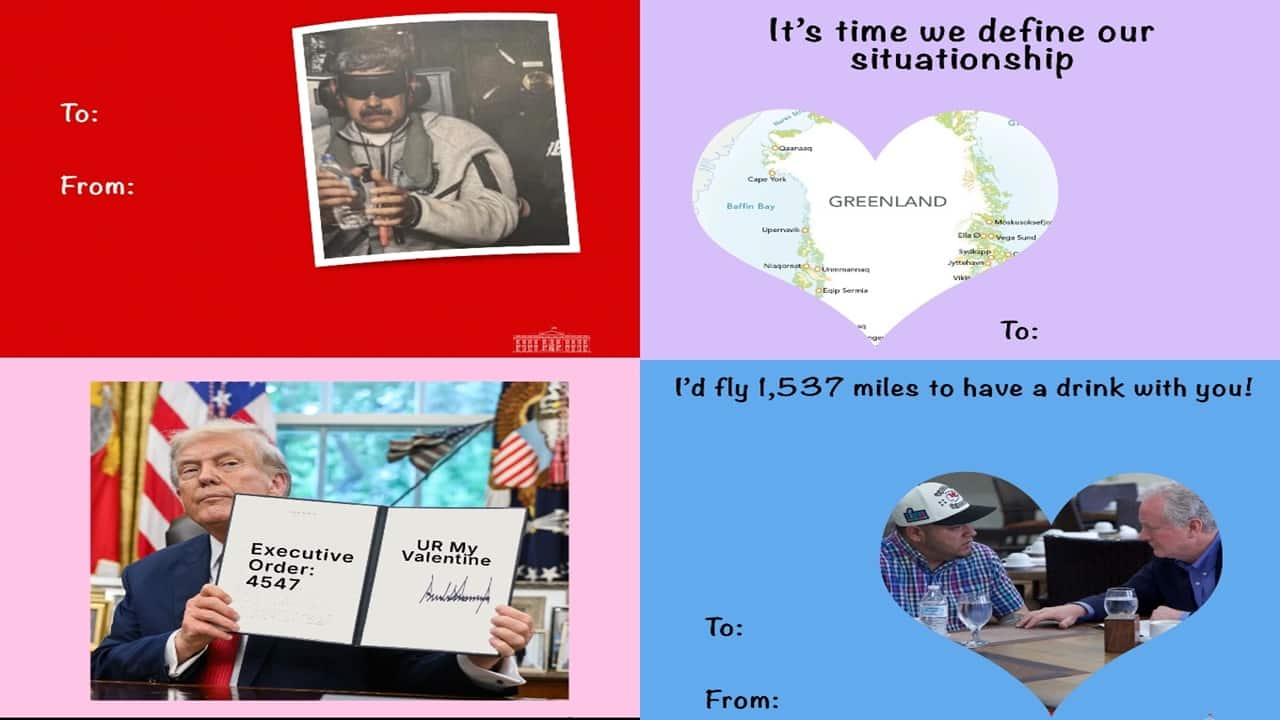
The White House unveiled its annual Valentine’s Day greeting cards on Monday, but this year’s designs have quickly moved beyond sentimentality. Two of the eight cards feature a stylized illustration of Venezuelan President Nicolás Maduro in handcuffs and a heart‑shaped map of Greenland, prompting a flurry of reactions from diplomats, analysts, and social‑media users worldwide.
A tradition with a twist
Since the early 2000s, the executive residence has released themed greeting cards for major holidays, ranging from Christmas to Easter. The cards are typically printed on high‑quality stock, signed by the first family, and distributed to staff, foreign dignitaries, and the public through the White House website. In recent years, the designs have leaned toward inclusive imagery—children of different ethnicities, iconic American landmarks, and messages of unity.
This year, the Office of Communications said the Valentine’s set was intended to “reflect the United States’ commitment to human rights and global partnership.” The statement highlighted three cards that address specific policy concerns: one showing a globe encircled by a peace ribbon, another depicting a climate‑action symbol, and the two controversial illustrations that have now become the focus of international discussion.
The handcuffed Maduro image appears on a card titled “Freedom First.” It shows the Venezuelan leader behind stylized handcuffs, with a faint silhouette of the Venezuelan flag in the background. The caption reads, “Love knows no borders—justice does.” The design aligns with the U.S. Treasury’s ongoing sanctions against Maduro’s government for alleged human‑rights abuses and corruption.
Venezuelan officials responded swiftly. A spokesperson for the Ministry of Foreign Affairs called the depiction “an unfounded political attack” and warned that it “undermines diplomatic dialogue.” The Venezuelan embassy in Washington requested a formal apology, citing the breach of diplomatic protocol.
U.S. State Department officials, speaking on condition of anonymity, said the cards were not intended as an official policy statement but rather as a “soft‑power” expression of American values. “The White House often uses cultural artifacts to signal priorities,” one official noted. “In this case, the imagery reinforces the administration’s stance on democratic governance in the Western Hemisphere.”
The second contentious card, labeled “Arctic Affection,” features a bright red heart shaped like the outline of Greenland, with a small U.S. flag planted at the top. The back of the card carries the line, “Our love for the planet knows no limits.”
The illustration arrived at a sensitive moment. In recent months, the United States, Canada, and several European nations have intensified discussions about Arctic sovereignty, resource extraction, and climate change. Greenland, an autonomous territory within the Kingdom of Denmark, has been at the center of strategic talks after China expressed interest in mining rights and the United States announced plans to expand its military presence in the region.
Danish officials expressed “surprise” but not outright condemnation. A senior diplomat in Copenhagen described the card as “a creative, if unconventional, nod to the growing importance of the Arctic.” Greenland’s own government, however, issued a brief statement emphasizing that any future development must respect the island’s environment and the wishes of its Inuit population.
Global reactions and media coverage
Within hours of the cards’ release, the images went viral on major platforms. The hashtag #WhiteHouseValentines trended in the United States, while #MaduroInCuffs and #GreenlandHeart sparked separate conversations in Latin America and Scandinavia. Opinion pieces in major newspapers ranged from praise for “courageous visual diplomacy” to criticism that the White House was “weaponizing holiday greetings.”
Political analysts point out that the cards are part of a broader shift in how the executive branch communicates policy positions. “Visual messaging is faster and more shareable than a press release,” said Dr. Elena Ruiz, a professor of international communication at Georgetown University. “By embedding policy cues in a cultural product, the administration can reach audiences that might ignore a formal statement.”
Potential diplomatic fallout
While the cards are unlikely to alter formal diplomatic negotiations, they could add pressure in ongoing talks. In Venezuela, the Maduro government has already signaled that it will raise the issue at the next meeting of the Organization of American States. In the Arctic arena, Denmark’s foreign ministry indicated that the United States’ symbolic gesture will be taken into account during upcoming bilateral discussions on military infrastructure.
Experts caution that the real impact will depend on how the administrations respond. “If the State Department issues a clarification or a diplomatic note, the controversy may subside quickly,” noted James Patel, a senior fellow at the Center for Strategic and International Studies. “If it escalates, we could see a brief cooling of relations, especially with Venezuela, where already‑tense ties are fragile.”
Inside Washington, reactions among lawmakers mirror the partisan divide. Some Republican members praised the cards as “a bold statement of American values,” while several Democratic representatives called for a review of the Office of Communications’ approval process. A bipartisan group of senators has scheduled a hearing to discuss the appropriateness of political imagery in official White House communications.
Public opinion appears split as well. A poll conducted by a major news network found that 42 % of respondents viewed the cards as an acceptable way to express U.S. policy, while 38 % felt they crossed a line into propaganda. Younger voters, particularly those active on social media, were more likely to see the cards as “creative advocacy.”
The White House has not announced any changes to the remaining cards in the set, which include more traditional designs such as a rose bouquet and a family portrait. However, the administration’s communications team is expected to issue a statement addressing the diplomatic concerns raised by the Maduro and Greenland images.
In the longer term, the episode may influence how future administrations approach holiday messaging. The balance between cultural expression and diplomatic sensitivity is delicate, and the rapid spread of visual content online means that even a greeting card can become a flashpoint.
The White House’s Valentine’s Day cards have turned a routine holiday tradition into a moment of international debate. By pairing a handcuffed Venezuelan leader with a heart‑shaped Greenland, the administration signaled its stance on human rights and Arctic policy in a format that reached far beyond the usual diplomatic channels. How the United States navigates the ensuing reactions will offer a glimpse into the evolving role of soft power in modern foreign affairs.